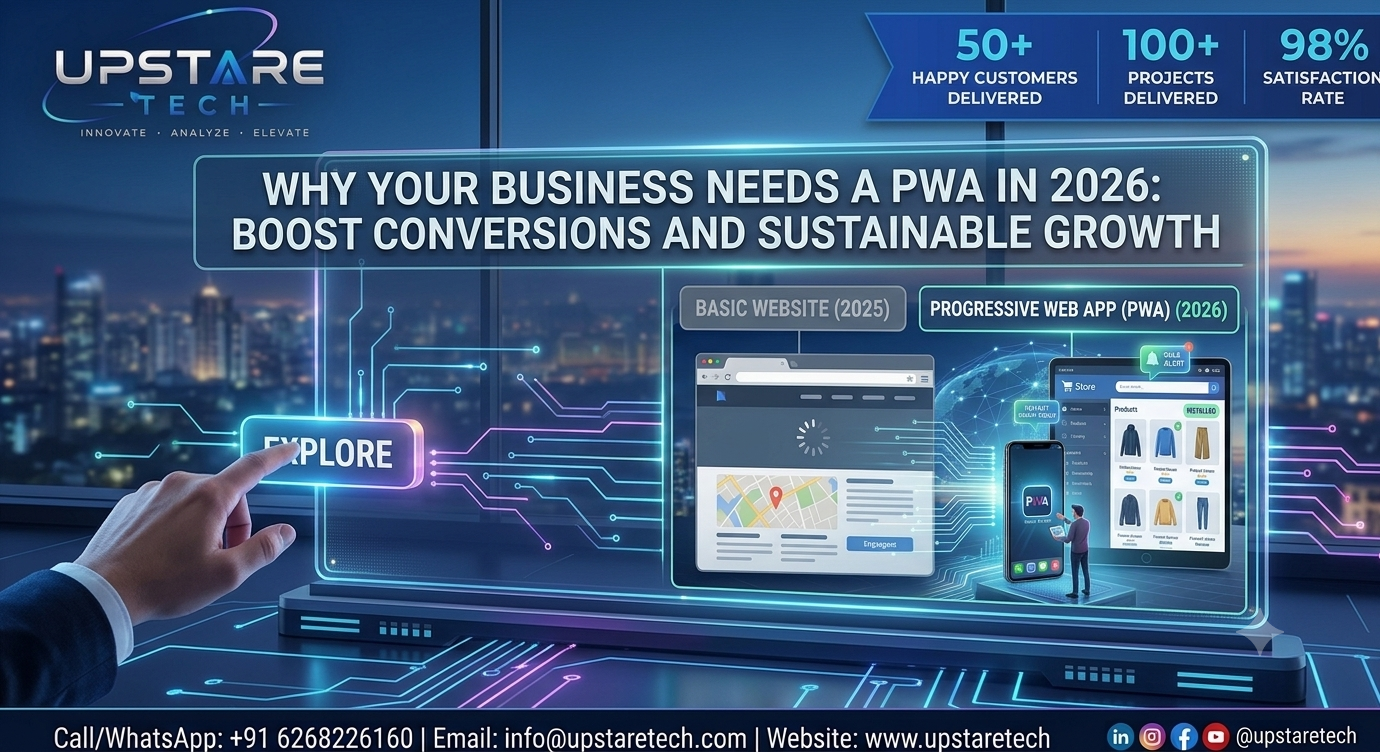
Why Your Business Needs a Progressive Web App (PWA) Instead of Just a Basic Website in 2026
Static websites no longer suffice in a mobile-first digital economy. Discover why upgrading to a Progressive Web App (PWA) in 2026 boosts conversions, lowers acquisition costs, and positions your business for sustainable growth.
By Upstare Tech4 min readTrend WatchPWA adoption, Web Development Trends 2026, Conversion Optimization
In 2026, user expectations for speed, convenience, and seamless digital interaction are at an all-time high. Consumers no longer differentiate between a "website" and an "app"—they simply expect immediate, reliable, and responsive experiences on every device.
While traditional websites once served as effective digital storefronts, they increasingly struggle to meet modern engagement standards. On the other end of the spectrum, native mobile applications carry high development costs, long delivery timelines, and the continuous friction of requiring users to download software from an app store.
This is where Progressive Web Apps (PWAs) deliver a strategic advantage. By blending the reach and accessibility of the open web with the performance and interactivity of native mobile apps, PWAs represent a fundamental shift in how growth-minded businesses approach their digital presence.
What Is a Progressive Web App?
A Progressive Web App is a website engineered with modern web capabilities—such as Service Workers and Web App Manifests—allowing it to function like a native mobile application.
Instead of opening a traditional browser tab that requires constant reloads, a PWA allows users to:
Access your site instantaneously via any web link.
Install the app directly onto their mobile or desktop home screen with a single tap (bypassing app stores).
Interact with fast, app-like page transitions and offline capabilities.
1. Eliminating User Friction to Boost Conversions
Every step required to access your business creates potential drop-off. Native apps require searching an app store, waiting for a download, approving permissions, and opening the app. Traditional websites, on the other hand, often suffer from slow reloads on unstable mobile connections.
A PWA eliminates these barriers:
Zero-Download Onboarding: Prospects interact with your full app experience instantly via URL or QR code.
Add to Home Screen: Users can save your app directly to their device home screen without visiting an app store, keeping your brand one tap away.
Higher ROI on Ad Spend: Marketing campaigns direct traffic straight to an installable, high-speed interface rather than sending users through app store redirection chains.
2. Offline Accessibility and Network Resilience
Traditional websites fail the moment a user enters a low-connectivity zone, loses service, or travels. PWAs leverage intelligent background caching through service workers to ensure your core content, product catalogs, or user dashboards remain accessible offline.
When connectivity drops, a PWA continues operating smoothly, queuing transactions or form submissions and syncing them automatically once the connection restores. This level of reliability protects customer trust and prevents abandoned carts or lost leads.
3. Re-Engagement via Native Web Push Notifications
Re-engaging visitors on a traditional website usually relies on email marketing, retargeting ads, or SMS—channels that suffer from declining open rates or rising acquisition costs.
PWAs support Web Push Notifications across major desktop and mobile browsers. You can deliver targeted messages, promotional updates, cart recovery reminders, and account alerts directly to a user’s screen, even when their browser is closed. This direct communication channel drives repeatable engagement and higher customer lifetime value (LTV).
4. Cost-Effective Cross-Platform Efficiency
Building and maintaining separate native applications for iOS and Android, alongside a desktop website, requires managing three separate codebases, distinct developer skill sets, and prolonged deployment cycles.
A PWA relies on a single, unified codebase (using standard web technologies like HTML, CSS, and JavaScript) that runs universally across Android, iOS, Windows, and macOS.
Key business advantages include:
Lower Total Cost of Ownership (TCO): Significantly reduced initial development and ongoing maintenance budgets.
Instant Deployments: Feature updates and security patches publish immediately to all users without waiting for app store approval processes.
Faster Time-to-Market: Focus resources on launching one optimized product rather than managing fragmented platforms.
5. Uncompromised SEO Visibility
Unlike native apps, which remain locked inside app store ecosystems, PWAs are fully indexable by search engines. You gain the organic discovery benefits of traditional SEO—driving search traffic directly to specific product pages or content—while serving visitors an ultra-fast, app-like experience upon arrival.
Search engines prioritize fast-loading, mobile-optimized digital experiences in search rankings. The inherent speed and architectural efficiency of a PWA directly support higher search visibility and lower bounce rates.
Adopting a Growth Mindset in 2026
Upgrading from a traditional website to a Progressive Web App is not merely an IT upgrade; it is a strategic business initiative. By delivering lower friction, faster speeds, offline capability, and cross-platform unified development, PWAs empower businesses to scale efficiently, improve customer retention, and maximize marketing ROI.
If your growth strategy for 2026 relies on providing memorable, fast, and frictionless digital experiences, transitioning to a Progressive Web App is the logical next step.
Need help? 👋Ask Upstare AI about our services, internships or your project.
Upstare AI AssistantOnline • Upstare Tech
Hi! 👋 Ask me about our services, pricing, internships or contact details.