
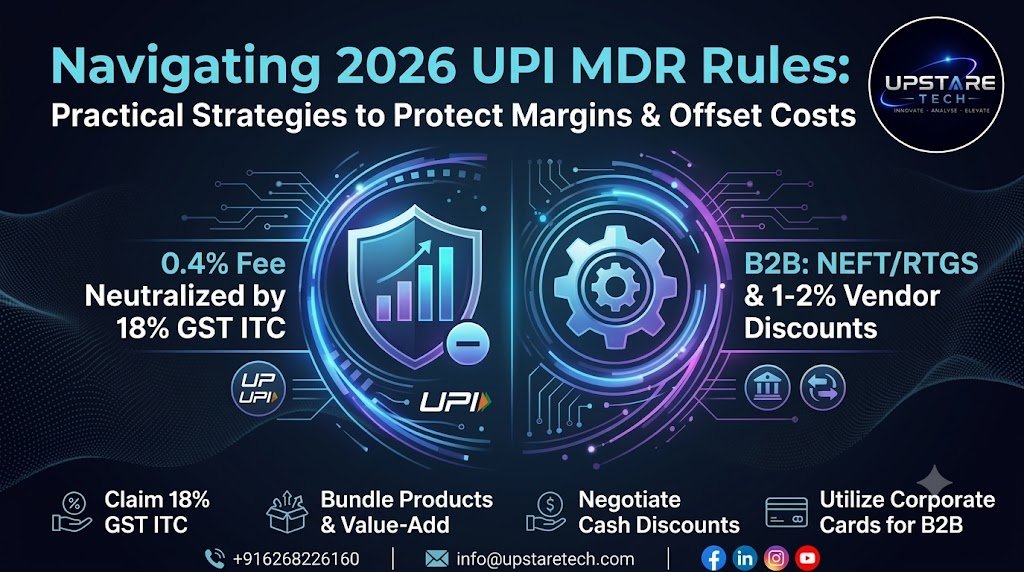
Below are practical, actionable strategies to help you maintain healthy profit margins while staying competitive.
Part 1: Strategies to Protect and Manage Your Profit Margins
1. Claim Your 18% GST Input Tax Credit (ITC)
The 0.4% MDR fee charged by banks attracts an 18% GST component.
- Action Item: Ensure your company's GSTIN is officially updated and linked to your bank current account.
- Financial Impact: By maintaining proper GST registration with your bank, you can claim the full 18% GST portion back as an Input Tax Credit (ITC) against your monthly output GST liability. This immediately reduces the net out-of-pocket cost of processing fees.
2. Promote Alternate Digital Payment Methods for High-Value Transactions
For larger customer bills (well above ₹2,000), consumer payment preferences can be guided toward lower-cost or capped channels.
- Action Item: Place clear signage or digital prompts at checkout showcasing RuPay Credit Cards on UPI or standard Debit Cards.
- Financial Impact: Depending on your specific sector agreements with your acquiring bank, card network MDR structures may offer lower negotiated flat rates or competitive caps compared to standard wallet or commercial UPI transactions.
3. Bake Transaction Costs Into Strategic Product Bundling
Rather than attempting price hikes on individual items, absorb transaction fees through margin expansion via product bundling.
- Action Item: Combine complementary products or services into value-add packages (e.g., core item + extended warranty, or tiered multi-buy offers at a slight premium).
- Financial Impact: Elevating the average order value and overall gross profit per ticket renders the minor 0.4% MDR fee virtually invisible on your final P&L statement.
Part 2: Leveraging B2B Payment Methods to Offset Costs
When interacting with wholesalers, manufacturers, and vendors, you transition from merchant to buyer.
Utilizing smart enterprise B2B payment tools allows you to gain financial advantages that offset retail-side processing costs.
1. Route Wholesale Payments via IMPS, NEFT, or RTGS
Paying suppliers through consumer-grade merchant UPI channels for large invoices can lead to unnecessary fees or processing friction.
- Action Item: Shift vendor payouts of large sums (e.g., ₹50,000 or ₹1,00,000+) to standard corporate electronic banking channels like NEFT, RTGS, or IMPS.
- Financial Impact: Corporate net banking transfers carry flat, minimal, or zero fees regardless of transaction size, avoiding percentage-based MDR charges entirely.
2. Secure Early Payment "Cash Discounts"
Suppliers and wholesalers are equally motivated to reduce cash handling costs and optimize their working capital.
- Action Item: Offer suppliers guaranteed, rapid bank-to-bank settlements via scheduled net banking payments in exchange for favorable invoice terms.
- Financial Impact: Negotiating a 1% to 2% "Cash Discount" (CD) on raw material or inventory invoices easily neutralizes and exceeds the 0.4% processing fee incurred during customer retail checkouts.
3. Maximize Working Capital with Corporate Credit Cards
Where accepted by vendors, utilize business credit cards for B2B procurement.
- Action Item: Pay recurring enterprise bills and inventory invoices using corporate credit accounts.
- Financial Impact: Corporate credit cards offer an interest-free billing cycle of 45 to 50 days. Keeping cash in your yield-bearing current account or liquidity reserve longer helps generate interest income and maintain working capital flexibility.
Conclusion
Adapting to updated digital payment regulations doesn't mean sacrificing your margins. By claiming eligible tax credits, optimizing checkout options, and utilizing strategic B2B payment methods, your business can effectively neutralize MDR fees and maintain a profitable payment ecosystem.