
How to Integrate Custom AI Chatbots That Actually Understand Your Business Logic
Most businesses today have experimented with AI chatbots. Whether built on off-the-shelf platforms or simple API wrappers around Large Language Models (LLMs), first-generation chatbots usually deliver mixed results. They can answer generic FAQ questions, but the moment a user asks a query requiring real business context—such as "Can I upgrade my subscription plan mid-cycle with my current credits?" or "What is the status of order #84920 under our negotiated corporate terms?"—the bot founders or provides inaccurate information.
To build a chatbot that delivers genuine ROI, you need an solution that does more than rephrase documentation: it must understand and execute your unique business logic.
Why Generic AI Chatbots Fail at Business Logic
Standard out-of-the-box LLMs are designed for generalized language understanding. They excel at fluency, but they lack awareness of your internal operations:
- Lack of Dynamic Context: Generic models cannot see your live inventory levels, custom customer tiers, or transactional rules without proper system integration.
- Hallucination Risks: Without deterministic safeguards, standard AI models may invent policies, offer unauthorized discounts, or make promises your systems cannot fulfill.
- Siloed Operations: An isolated chatbot acts purely as a search bar, requiring manual human intervention whenever an actual action (like issuing a refund or updating a CRM lead) needs to happen.
The Architectural Blueprint for Business-Aware AI Chatbots
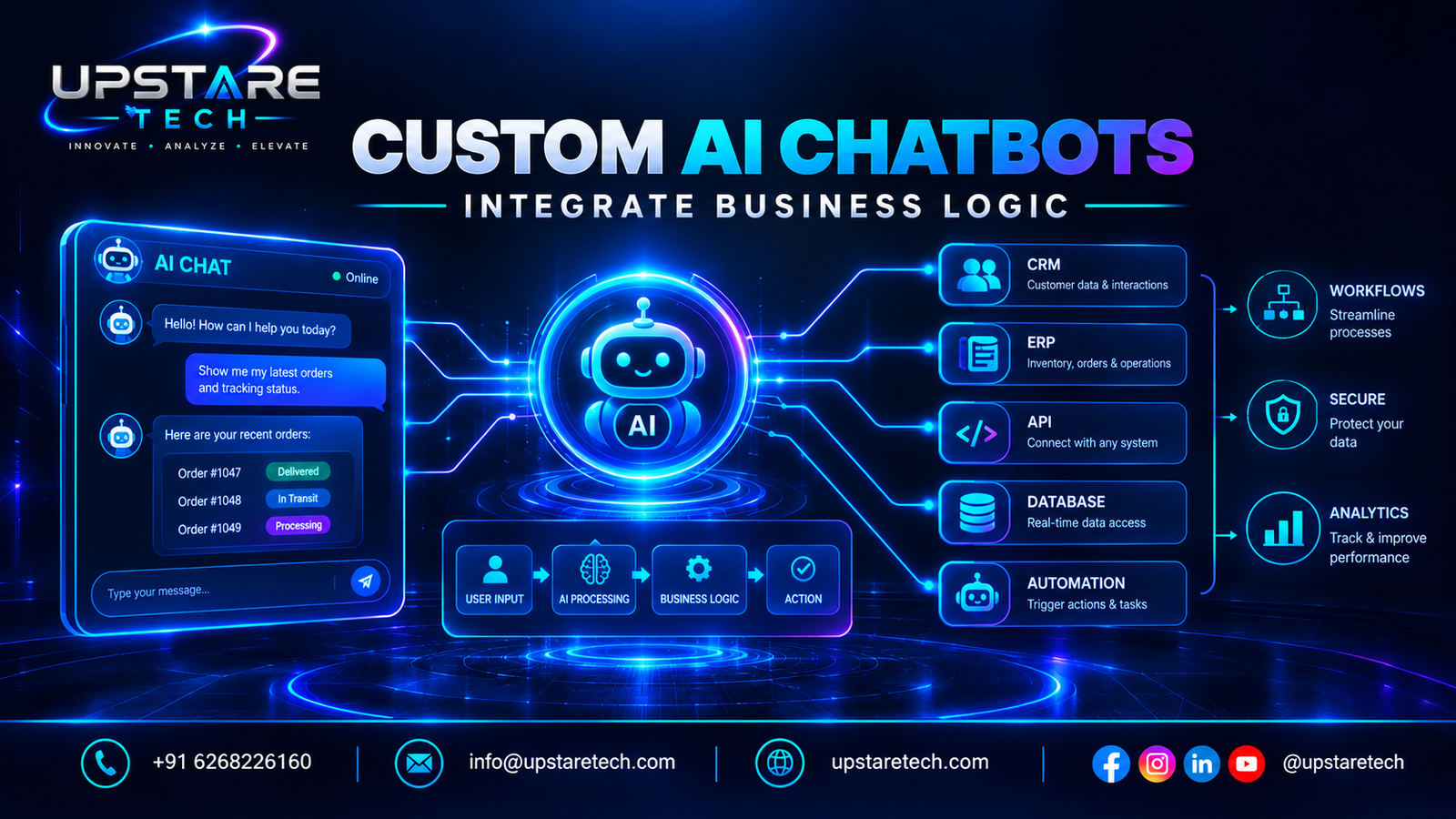
Creating an AI chatbot capable of executing business rules requires a hybrid system architecture combining modern LLM capabilities with traditional engineering safeguards.
1. Retrieval-Augmented Generation (RAG) for Accurate Data Access
Instead of relying on an LLM's pre-trained knowledge base, custom chatbots use Retrieval-Augmented Generation (RAG). When a user asks a question:
- The system searches your enterprise knowledge base (internal docs, product manuals, policy PDFs) stored in a Vector Database.
- It retrieves only the relevant snippets.
- It feeds those exact snippets into the prompt, forcing the LLM to generate responses grounded strictly in your factual documentation.
2. Function Calling and API Integrations for Actionability
A truly useful chatbot doesn't just inform—it executes. By leveraging Tool Use / Function Calling, the AI can determine when a user request requires external action:
- CRM / ERP Integration: Pulling customer purchase histories, contract terms, or account statuses.
- Database Queries: Checking live inventory or appointment schedules.
- Workflow Automation: Creating support tickets in Zendesk or updating sales leads in Salesforce.
3. Middleware Rules Engine (The Business Logic Guardrails)
Never rely entirely on an LLM to decide whether a business transaction is valid. A robust architecture places a deterministic rules engine between the AI and your backend systems.
For example, if the AI understands that a customer wants a refund, the decision engine validates:
- Is the purchase within the 30-day window?
- Is the user on a non-refundable enterprise tier?
- Does the refund amount exceed the automatic threshold ($100)?
If valid, the API call succeeds. If invalid or ambiguous, the request is safely routed to a human representative.
Key Steps to Successfully Integrate a Custom AI Chatbot
Step 1: Map Out Your Workflows and Edge Cases
Before writing code, document your high-frequency customer and internal workflows. Identify:
- Required data sources (APIs, SQL databases, CMS).
- Security rules (data masking, role-based access controls).
- Hard business constraints (pricing logic, authorization levels).
Step 2: Implement Robust Role-Based Access Controls (RBAC)
Not all users should have access to the same data. A custom AI engine must enforce strict security permissions. An account executive asking about client pricing should receive detailed terms, while an external customer should only see public pricing tiers.
Step 3: Human-in-the-Loop (HITL) Handoffs
A key element of effective business logic integration is knowing when not to automate. Ensure your AI workflow includes seamless handoffs to human agents when confidence scores fall below a set threshold or when high-value transactions occur.
Transforming AI into an Operational Engine
Integrating a custom AI chatbot that truly comprehends your business logic transforms customer support and internal workflows from cost centers into growth drivers. By combining RAG, API Function Calling, and Deterministic Rules Engines, your business gains an intelligent assistant that operates with precision, compliance, and real execution power.
Ready to Build a Tailored AI Solution for Your Enterprise?
At Upstare Tech, we specialize in designing and deploying custom AI solutions, intelligent automation workflows, and enterprise system integrations tailored specifically to your business rules.
Contact Upstare Tech today to discuss your AI integration strategy.